Film Narration as Comfort and an Intimate Bond
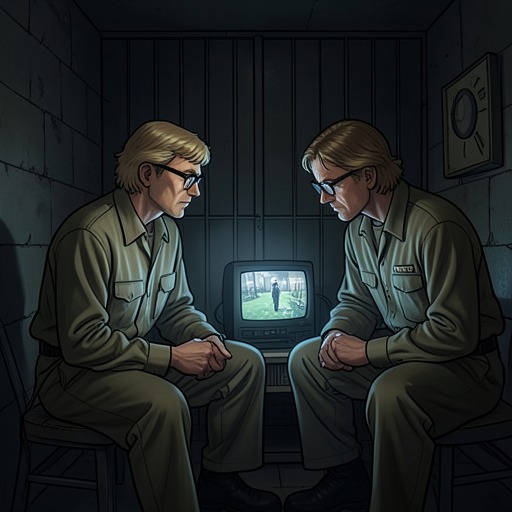
Kiss of the Spider WomanFilm narration in the conversations between Molina and Valentin serves at once as an imaginative refuge and a practice of intimacy. By rebuilding films in speech—through settings, costumes, music, lighting, and turns in a story—Molina gives Valentin somewhere to direct his attention beyond prison. The stories also make room for a quieter exchange: Valentin asks for their continuation, Molina promises to finish one, and their shared listening persists into the novel’s dreamlike ending.
Spoken Images and Cinematic Detail
Molina’s accounts make film present through selected visual and auditory particulars. One begins in a famous Paris music hall, with dark velvet upholstery and chrome railings. A chorus line changes its appearance as the music turns: the dancers first appear in black, then blonde and glittering in strips of strass. The description follows the performance’s changes rather than reducing it to a plot outline; the movement, costumes, and camera’s focus are part of what Molina narrates.
Another performance emerges through a sequence of theatrical effects. After the stage falls dark, a woman’s silhouette becomes clearer behind layers of tulle. Her silver lamé gown and descent along illuminated steps turn the staging into a series of images, punctuated by flashes of light. Molina’s spoken account recreates the scene through gradual revelation, as if the listener were watching the figure come into focus.
Other stories build their worlds through contrasts and carefully chosen settings. In one, guests gather around a blind pianist at a house in the forest, where the furnishings, open windows, candlelit room, and grand piano establish the atmosphere before the music begins. In another, the final hours of the Mardi Gras of Veracruz unfold at a coastal villa: fishermen are heading out before daybreak, masked couples remain on the dance floor, and the approaching Ash Wednesday marks the celebration’s end. The accounts move between spectacle and impending change, making setting and sound carry as much narrative weight as action.
Listening as a Shared Practice
The stories are not simply material Molina supplies while Valentin remains passive. Valentin asks him to tell the rest of a film, noting that Molina has not wanted to continue it in recent days. Molina agrees to finish the whole story and promises not to pester Valentin with his own problems afterward. That exchange gives the narration a reciprocal shape: Valentin requests the story, Molina responds, and the promise to continue becomes part of their conversation, not merely a service delivered by one prisoner to another.
The repeated acts of telling and listening acquire particular force against the conditions of the cell. Valentin explains that political prisoners fear the infirmary because treatment there could weaken a prisoner’s resistance under interrogation. As his own illness worsens, he calls for help; Molina assists with practical care, including wiping him with a damp piece of clean sheet, and warns him against taking a freezing shower in his condition. These moments are not themselves film narration, but they show the vulnerable circumstances in which the conversations take place. The stories give the men a shared activity while care makes their dependence on one another concrete.
Valentin’s words also connect the stories to his emotional life beyond the cell. In a moment of confusion and illness, he distinguishes fear for his girl from his longing for Marta, whom he identifies as the person he most wants to see and hold. Film narration does not erase these attachments or resolve his uncertainty. Instead, the conversations provide a form in which attention, memory, fear, and longing can coexist without being reduced to a single subject.
From Film Ending to Dream
The last film Molina recounts becomes a particularly clear meeting point between narrative and companionship. After the masked celebration, a magnate searches for a woman he had wronged, finds her living in poverty, and apologizes. He gives her a case of jewels and leaves; she then searches for the man she loves. Valentin responds to the story with sadness and calls its ending enigmatic. The exchange leaves the film’s resolution open to feeling and interpretation rather than closing it into a simple judgment.
The film’s imagery returns in the concluding dream. Valentin counts steps while exhausted and imagines being guided by a doctor; Marta also appears in his thoughts and speaks with him. As he pictures reaching an island and finding food, the scene recalls the earlier film description: a strange woman in a shining long dress, wearing a mask and trapped in a web that grows from her body. The remembered silver costume links the dream’s landscape to Molina’s earlier cinematic narration. Here, the film is not merely recalled as a completed tale: its images become part of the language through which Valentin imagines survival and companionship.
In the dream, Valentin and Marta speak about remaining present in one another’s thoughts, and he imagines returning to his comrades after resting. Yet he cannot tell her their names, fearing that disclosure would separate them; Marta reassures him within the dream. The scene holds political commitment, secrecy, exhaustion, and longing together without resolving their tensions. Its reassurance belongs to the dream, not to a change in the external circumstances of the prison.
Narrative and Emotional Significance
Across these episodes, Molina’s storytelling transforms cinema from a subject of conversation into a means of relating. The accounts depend on spoken language, but they repeatedly evoke film’s capacity to organize attention through framing, performance, light, costume, music, and revelation. Their detail gives Valentin something to follow; his requests and responses, in turn, make the telling a shared event rather than a solitary escape.
The ending draws that formal pattern inward. Images first encountered as part of narrated entertainment reappear within Valentin’s dream, alongside Marta and thoughts of the comrades he cannot name. Film narration thus offers neither a cure for illness nor an escape from political danger. Its significance lies in the temporary imaginative space it makes and in the bond sustained through the act of telling, listening, and returning to a story together.